
Introduction to Investing in India

Table of Contents
- Investing in India: The Ultimate Guide to Building Wealth.
Have you ever wondered how some people consistently build wealth, while others struggle financially despite earning a good income?
The answer often lies in a simple habit…
Investing in a disciplined manner!
Many Indians believe that investing is only for those with high salaries or significant financial knowledge. In reality, anyone can start investing with a small amount and gradually build their wealth. Whether you are a student, a salaried employee, a freelancer, an entrepreneur, or retired, investing can help you achieve your essential financial goals.
India is one of the fastest-growing economies in the world. Thanks to the expanding reach of digital services, improved financial literacy, and user-friendly investment platforms, investing has become easier than ever.
However, the biggest challenge is not opening an investment account—but rather understanding where to invest, how much to invest, and how to avoid common mistakes.
This comprehensive guide, titled “Investing in India: The Ultimate Guide to Building Wealth in 2026,” will help you understand exactly that.
In this pillar article, you’ll learn:
What is the true meaning of investing?
Why is investing important in India?
What are the various investment options available?
How do risk and returns work?
How can one build an investment portfolio?
What common mistakes should beginners avoid?
Which investment options in india offer tax benefits?
How can strategies for long-term wealth creation be formulated?
By the end of this guide, you will have a clear roadmap to start your investment journey with full confidence.
What Is Investing?
Investment means putting your money into assets that have the potential to appreciate over time. Instead of letting your money sit idle in a savings account, investing makes your money work for you.
Think of investing like planting a tree.
When you sow a seed today, it takes time to grow. You water it regularly, protect it from harm, and remain patient. Years later, it becomes a large tree that provides fruit and shade.
Investing works in the same way.
You invest money consistently, let it grow through compounding, and over the years, this can build significant wealth.
- Learn how to invest through an IPO in this article.
Investing vs Saving
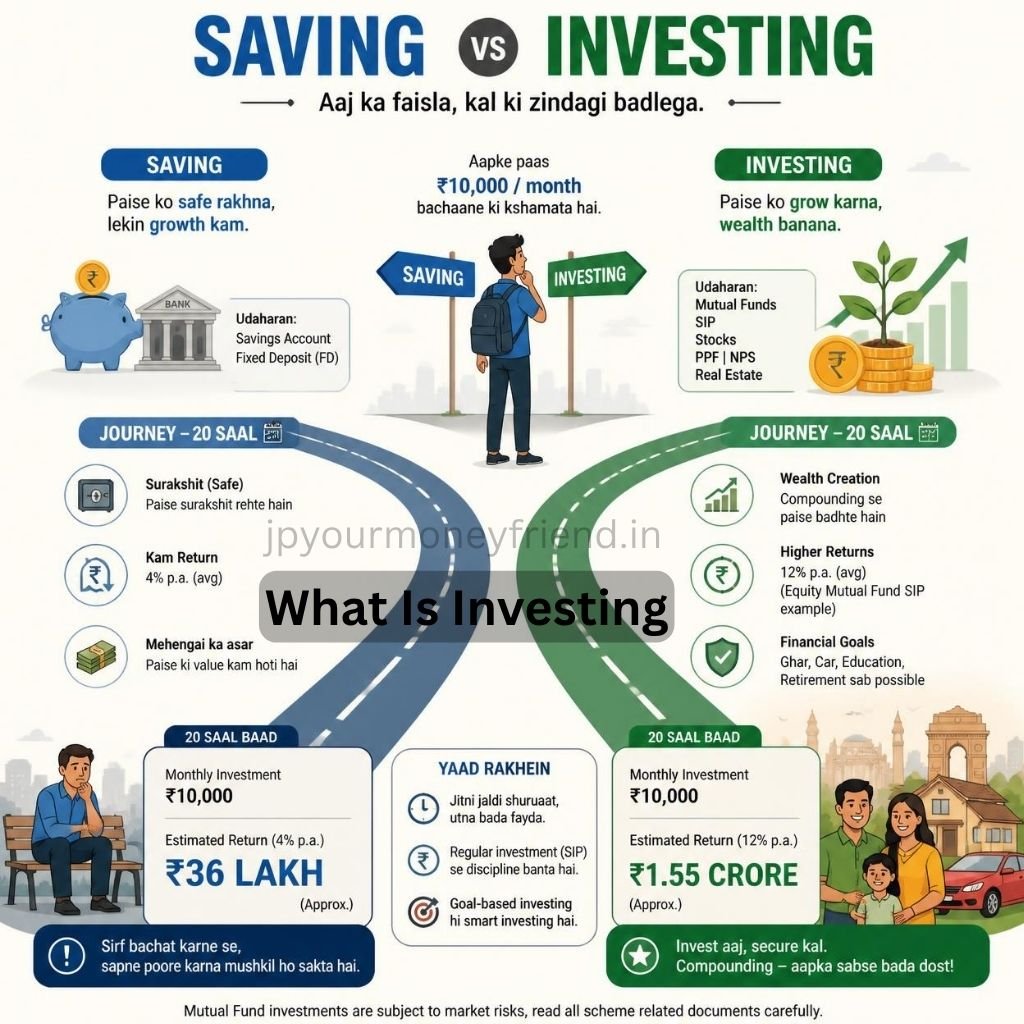
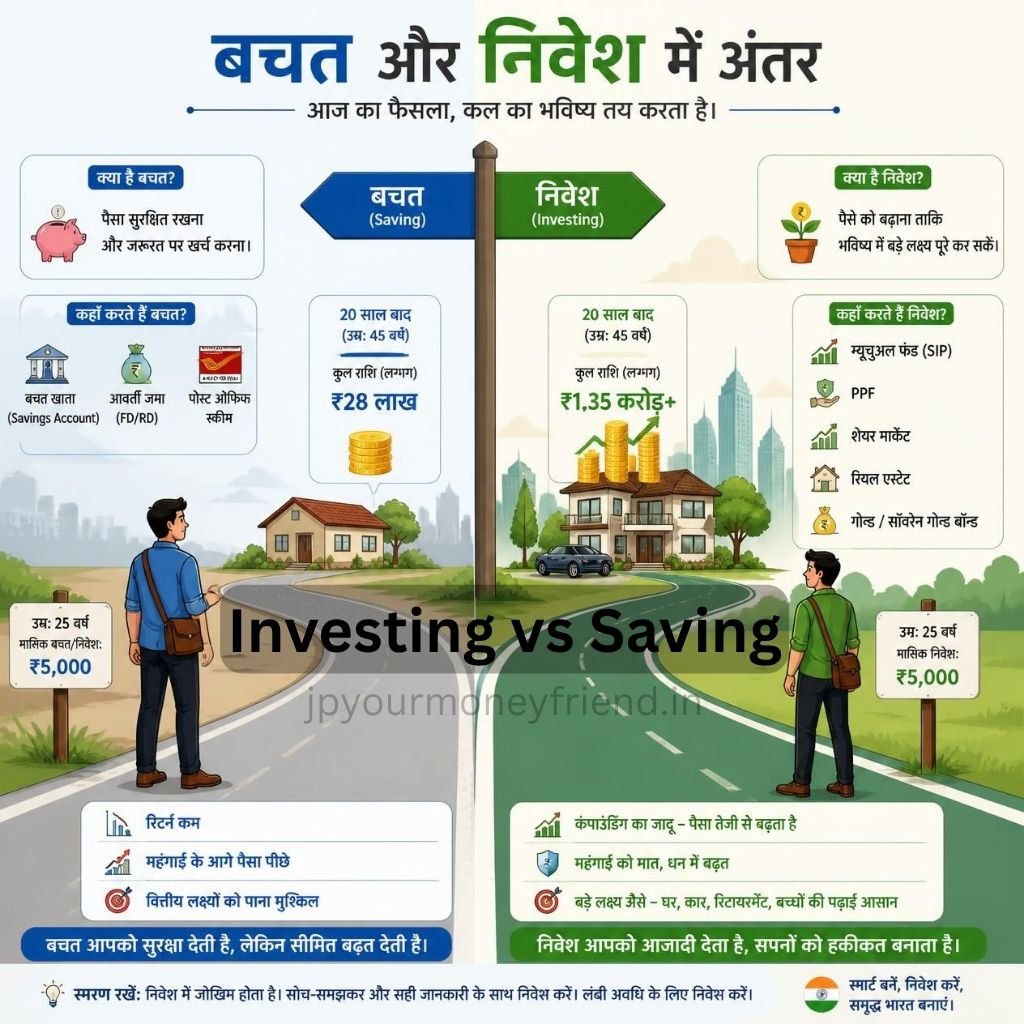
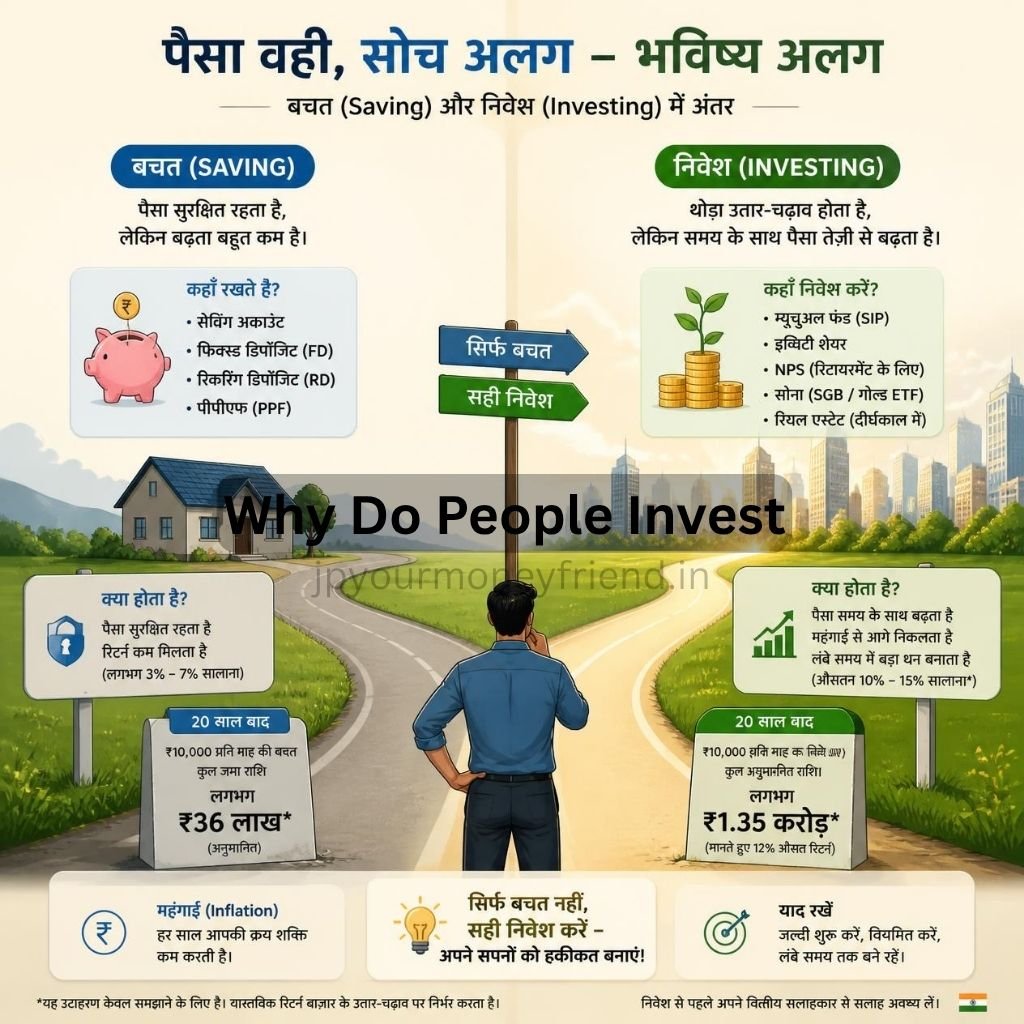
Many beginners get confused between saving and investing; although both are essential, they serve different purposes.
| Saving V/S Investing |
| Saving | Investing |
| Keeps money safe | Helps money grow |
| Low risk | Moderate to high risk |
| Lower returns | Higher potential returns |
| Short-term goals | Long-term goals |
| High liquidity | Varies depending on investment |

Why Do People Invest?
People invest for different reasons, including:
- Building wealth
- Buying a house
- Children’s education
- Retirement planning
- Financial independence
- Beating inflation
- Creating passive income
Regardless of your income level, investing helps you get closer to your financial goals.
Why Investing Is Important in India
India has witnessed rapid economic growth over the past few decades. Rising incomes, expanding industries, digital financial services, and a growing middle class have created more investment opportunities for people.
However, merely earning money is no longer enough.
Inflation gradually erodes the purchasing power of your savings.
For example:
If the average annual inflation rate remains at 6%, an item costing ₹100 today could cost approximately ₹180 or more in ten years.
If your money remains solely in a savings account and earns a return lower than the inflation rate, its real value diminishes over time.
Investing helps your money grow faster than inflation.
Benefits of Investing
1. Beat Inflation
An investment can yield returns that help maintain or increase your purchasing power over the long term.
2. Build Wealth
Consistent investing allows your money to grow through capital appreciation and compounding. Over time, even a small monthly investment can grow into a substantial sum.
3. Achieve Financial Goals
Whether you want to buy a home, travel abroad, save for higher education, or start a business, investing helps you work systematically towards achieving these goals.
4. Create Passive Income
Certain investments provide regular income from sources such as investments, dividends, interest, bond coupons, and rental income.

Passive income can provide additional financial security.
5. Prepare for Retirement
With rising life expectancy, retirement planning has become more important than ever. Investing early gives your money several decades to grow.
6. Financial Independence
One of the biggest benefits of investing is achieving financial freedom. Instead of relying solely on your monthly salary, your investments begin to build wealth alongside your active income.
How Investing Works
Understanding how investments work is far easier than most people think.
The basic process looks like this:
Income → Save → Invest → Earn Returns → Reinvest → Grow Wealth
Let’s break it down.
Step 1: Earn Money
Your investment journey begins with income from your job, business, freelancing, or other sources.
Step 2: Save a Portion
Before spending everything, set aside a specific portion for investment.
Many financial experts recommend investing 20–30% of your income, although the exact amount depends on your personal circumstances.
Step 3: Choose Investments
Your money can be invested in different assets such as:
- Choose the right option for yourself between trading or investing.
- Stocks
- Mutual funds
- Gold
- Bonds
- Fixed deposits
- Public Provident Fund (PPF)
- National Pension System (NPS)
- Exchange-Traded Funds (ETFs)
- Real estate
Each option has different levels of risk, return, and investment duration.
Step 4: Earn Returns
Investments may grow in several ways:
- Price appreciation
- Dividends
- Interest income
- Rental income
The type of return depends on the investment.
Step 5: Reinvest Your Earnings
One of the most effective ways to build wealth is to reinvest your returns instead of spending them. This generates additional earnings from your investment, creating a compounding effect over time.
The Magic of Compounding
Albert Einstein is often credited with calling compound interest the “eighth wonder of the world” (although this is also a subject of debate). It does not matter who said it; the principle itself is very powerful.
Imagine you invest ₹5,000 every month.
If your investment earns an average annual return of 12%, your total invested amount over 25 years would be ₹15 lakh; however, the portfolio’s value could be many times higher than that, as you begin to earn returns on your returns as well.
The sooner you start, the greater the impact of compounding will be.
The key takeaway: Instead of trying to time your entry or exit in the market, staying invested for the long term is generally more important.
Understanding Risk and Return
Every investment carries some degree of risk. Generally, higher potential returns come with higher risk. Understanding this relationship helps you make better investment decisions.
What Is Investment Risk?
Risk refers to the possibility that an investment may not perform as expected or that its value may decline.
For example:
- Stock prices may decline.
- Real estate prices can stagnate.
- Gold prices fluctuate.
- Mutual funds experience market volatility.
Risk cannot be eliminated, but it can be managed.
Types of Investment Risk
Market Risk
Prices fluctuate due to economic conditions, political events, interest rates, and investor sentiment.
Inflation Risk
If the return on your investment is lower than the inflation rate, your purchasing power diminishes over time.
Credit Risk
This is the risk that a borrower may fail to make interest or principal payments; it applies particularly to certain bonds and debt instruments.
Liquidity Risk
There are some investments that are difficult to sell quickly without affecting their price.
Real estate is a common example of this.
Interest Rate Risk
Changes in interest rates can affect the value of fixed-income investments such as bonds.
| Risk vs Return |
| Risk Level | Potential Return |
| Low | Low |
| Moderate | Moderate |
| High | High |
Understanding your comfort level with risk is just as important as understanding the investment itself.
How to Reduce Investment Risk
You cannot eliminate risk, but you can reduce it:
To achieve this, you need to diversify your investments, invest regularly through SIPs, stay invested for the long term, avoid emotional decisions, and periodically review your portfolio.
Setting Financial Goals Before Investing
One of the biggest mistakes beginners make is investing without a clear goal.
Before choosing any investment, ask yourself:
Why am I investing?
Your answer will determine where and how you should invest.
Types of Financial Goals
Short-Term Goals (0–3 Years)
This includes emergency expenses, purchasing a smartphone or laptop, planning a vacation, wedding expenses, and home repairs or renovations.
These goals typically require safe and highly liquid investment options.
Medium-Term Goals (3–7 Years)
This includes buying a car, starting a business, making a down payment on a house, saving for higher education, etc.
These goals may include a balanced mix of growth-oriented and stable investments.
Long-Term Goals (7+ Years)
This can encompass scenarios such as retirement planning, children’s education, wealth creation for future generations, and achieving financial freedom.
Long-term goals often allow investors to take on greater market exposure, as they have ample time to weather short-term fluctuations.
SMART Financial Goals
An effective financial goal should be:
- Specific – Clearly define what you want to achieve.
- Measurable – Assign a target amount.
- Achievable – Keep the goal realistic.
- Relevant – Align it with your priorities.
- Time-bound – Set a clear deadline.
For example:
I want to save ₹20 lakh for my child’s higher education over the next 10 years.
A goal like this provides direction and helps you estimate how much you need to invest each month.
Why Goals Matter
When your investments are tied to meaningful goals, you’re more likely to:
Stay disciplined during market fluctuations, avoid impulsive buying and selling, invest consistently, track your progress over time, and build confidence in your financial journey.
In this article, we will explain investment options and delve deeper into building your portfolio.
Build an Emergency Fund Before You Invest
One of the biggest mistakes beginners make is investing all their savings without setting aside any money for emergencies.
Imagine this scenario:
You invest ₹2 lakh in the stock market. Two months later, a sudden medical emergency arises, and you immediately need ₹1 lakh. If the market is down, you might have to sell your investment at a loss.
That is why every financial plan should start with an emergency fund.
An emergency fund is money set aside for unexpected situations such as medical emergencies, job loss, car or home repairs, family-related emergencies, sudden travel, or a business downturn.
How Much Should You Save?
A simple rule is that salaried individuals should maintain a fund covering 3–6 months of expenses, while freelancers, business owners, and those with irregular income should set aside a fund covering 6–12 months of expenses, so that the money can be utilized if such a situation arises.
For example:
If your monthly expenses are ₹40,000:
- Minimum emergency fund = ₹1.2 lakh
- Ideal emergency fund = ₹2.4 lakh
Where Should You Keep It?
Your emergency fund should be easily accessible, safe, and low-risk.
High-interest savings accounts, liquid mutual funds, sweep-in fixed deposits, and similar options can be good options for an emergency fund.
Important advice to keep in mind!
You should avoid investing your emergency fund in assets like stocks, equity mutual funds, real estate, and cryptocurrency.
- Remember: An emergency fund is not an investment—it is a means of financial security.
Best Investment Options in India
- Now you will learn how to invest in India and best investments in india?
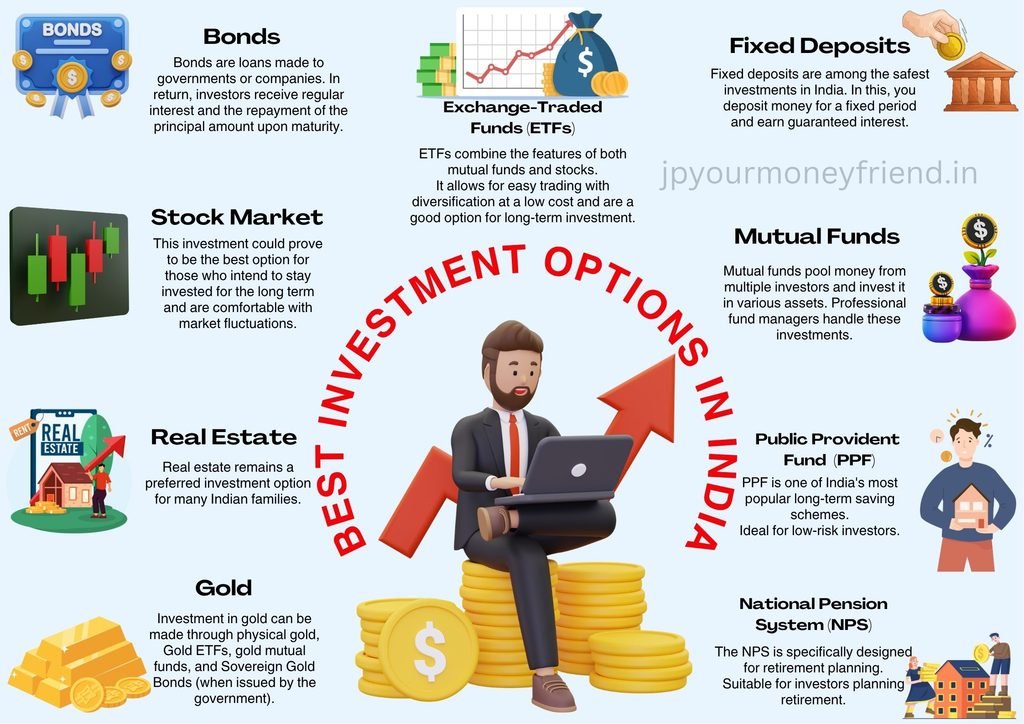
There are various investment options available in our country, each with its own level of risk, return potential, and suitability. Let us explore the most popular investment options in India.
A. Stocks (Equity)
Buying stock means purchasing a small share of ownership in a company. When a company grows, its share price may rise, allowing investors to make a profit.
Advantages
It offers the potential for higher long-term returns, generates income through company dividends, and provides a stake in the business that is very easy to buy and sell.
Risks
However, its prices fluctuate daily; this requires patience, and its value can decrease over a short period.
Best For:
This investment could prove to be the best option for those who intend to stay invested for the long term and are comfortable with market fluctuations.
B. Mutual Funds
Mutual funds pool money from multiple investors and invest it in various assets. Professional fund managers handle these investments.
Advantages include:
- Diversification
- Professional management
- Suitable for beginners
- SIP option available
C. Fixed Deposits (FD)
Fixed deposits are among the safest investments in India. In this, you deposit money for a fixed period and earn guaranteed interest.
Pros
- Low risk
- Fixed returns
- Predictable income
Cons
- Lower returns
- Inflation may reduce real returns
D. Public Provident Fund (PPF)
PPF is one of India’s most popular long-term saving schemes.
Features include:
- Government-backed
- Long-term wealth creation
- Tax benefits
- Attractive interest rates (subject to periodic revisions)
Ideal for low-risk investors.
E. National Pension System (NPS)
The NPS is specifically designed for retirement planning.
Benefits include:
- Tax advantages
- Long investment horizon
- Equity and debt allocation
- Low management cost
Suitable for investors planning retirement.
F. Gold
Traditionally, gold has been one of the most preferred investment options in India.
Investment in gold can be made through physical gold, Gold ETFs, gold mutual funds, and Sovereign Gold Bonds (when issued by the government).
Gold helps diversify a portfolio, but generally, it should not be the only investment.
G. Bonds
Bonds are loans made to governments or companies. In return, investors receive regular interest and the repayment of the principal amount upon maturity.
Generally less volatile than stocks.
H. Real Estate
Real estate remains a preferred investment option for many Indian families.
Advantages:
- Tangible asset
- Rental income
- Long-term appreciation potential
Challenges:
- Requires significant capital
- Lower liquidity
- Ongoing maintenance costs
I. Exchange-Traded Funds (ETFs)
ETFs combine the features of both mutual funds and stocks.
It allows for easy trading with diversification at a low cost and are a good option for long-term investment.
Comparing Investment Options
| Investment | Risk | Return Potential | Investment Horizon |
| Savings Account | Very Low | Low | Low |
| Fixed Deposit | Low | Low–Moderate | Short–Medium |
| PPF | Low | Moderate | Long |
| Bonds | Low–Moderate | Moderate | Medium |
| Gold | Moderate | Moderate | Long |
| Mutual Funds | Moderate | Moderate–High | Long |
| Stocks | High | High | Long |
| Real Estate | Moderate–High | Moderate–High | Long |
| ETFs | Moderate | Moderate–High | Long |
Mutual Funds Explained
Mutual funds are one of the easiest ways for beginners to start investing. Instead of selecting individual stocks yourself, a professional fund manager invests the money on your behalf.
How Do Mutual Funds Work?
Thousands of investors pool their money together. A fund manager invests these funds in stocks, bonds, money market instruments, and other securities, and returns are distributed to investors based on the number of units they hold.
Types of Mutual Funds
Equity Mutual Funds
They primarily invest in company shares. Equity mutual funds are suitable for those looking to build wealth over the long term, as they offer the potential for better returns.
Debt Mutual Funds
These primarily invest in bonds and fixed-income securities. Such mutual funds are suitable for those seeking stable returns with low risk.
Hybrid Funds
Such mutual funds invest in both equity and debt. They are suitable for investors who seek balanced risk.
Index Funds
Such funds track stock market indices like the Nifty 50 or Sensex. Investing in these funds involves lower costs, facilitates passive investing, and gives ordinary investors access to the broader market.
SIP vs Lump Sum
SIP (Systematic Investment Plan)
Invest a fixed amount every month. Example: ₹5,000 every month.
- Be sure to watch this short video to get a good understanding of SIPs in just one minute.
SIP instills the habit of disciplined investing, reduces market-timing risks, makes investing affordable, and is ideal for salaried individuals.
Lump Sum Investment
A lump sum investment means investing a large amount of money at once. This investment method is suitable when you receive a bonus, sell an asset, or inherit money.
Why SIP Is Popular
SIPs are more popular because they offer the benefits of rupee cost averaging and compounding; we learn financial discipline, and our money remains flexible.
For most newcomers, an SIP is often a practical way to get started, as it encourages consistent investment without requiring a large initial amount.
Stock Market Investing
The stock market allows investors to purchase shares of publicly listed companies. When companies perform well over time, shareholders can benefit from capital appreciation and dividends.
Why Do People Invest in Stocks?
- Historically, stocks have been one of the best-performing asset classes over the long term.
Stocks have the potential for rapid growth, generate additional income through dividends paid by companies, provide a stake in the company’s business, and offer liquidity (the ability to easily convert them into cash).
How to Start Investing in Stocks
Investing in the stock market has become very easy these days; we can open a Demat and trading account in as little as 30 minutes by completing the KYC process and transferring funds. Then, research companies and gradually start investing.
Fundamental Analysis
Before buying a stock, we should evaluate factors such as the company’s revenue, profit growth, debt levels, management quality, competitive advantage, and future growth prospects.
Technical Analysis
Some investors use price charts and trading volume to identify potential buying or selling opportunities. Technical analysis is generally associated with short-term trading rather than long-term investment.
Common Beginner Mistakes
We should not make purchasing decisions based on discussions circulating on social media; investing without research can be detrimental.
We should avoid investing out of a desire for quick gains and refrain from panic-selling shares during market downturns; instead, diversification can prove beneficial during such times.
Long-Term Investing Wins
Investors who consistently invest in high-quality companies over the long term with patience—and stay invested—are considered successful investors.
Instead of trying to predict short-term market fluctuations, they allow time and business growth sufficient opportunity to work to their advantage.
Gold Investments in India
In India, gold has long been considered a symbol of wealth and financial security. However, today’s investors have several other ways to invest in gold beyond just purchasing jewelry.
Physical Gold
It is classified as a tangible asset and is widely accepted—qualities that highlight its advantages—whereas costs such as making charges for gold jewelry, storage concerns, and issues regarding purity represent some of its downsides.
This includes jewelry, coins, and gold bars.
Gold ETFs
Gold Exchange-Traded Funds (Gold ETFs) invest in physical gold and are traded on stock exchanges.
For an investor, being a digital form of gold means there are no storage issues, buying and selling is easy, and prices are more transparent.
Gold Mutual Funds
These invest in gold ETFs and may be suitable for investors who prefer mutual fund platforms.
Sovereign Gold Bonds (SGBs)
Sovereign Gold Bonds are government-guaranteed securities linked to the price of gold. Investors have previously had the opportunity to invest in gold through these instruments and earn periodic interest, but the issuance of new bonds depends on government policy.
For an investor, these entail no storage costs and enjoy government backing; interest is automatically credited to the account as and when due, and there is also the potential benefit of capital gains tax treatment upon redemption, subject to applicable rules.
- Before planning to invest, always check if new SGB issues are currently available.
How Much Gold Should You Own?
Many financial planners suggest investing about 5% to 15% of a diversified investment portfolio in gold, depending on your financial goals and risk profile.
Gold can help mitigate fluctuations across an entire portfolio, but relying too heavily on it limits long-term growth compared to diversified equity investments.
Fixed-Income Investment Options in India
Fixed-income investments aim to provide relatively stable returns and preserve the original capital. These play an important role in balancing the excessive fluctuations in equity investments.
Fixed Deposits (FDs)
FDs are offered by banks and some financial institutions.
Talking about the benefits of FDs, they offer returns based on fixed interest rates, whereby the amount received on maturity is fixed in advance; hence, they prove to be a very useful investment for those who do not want to take more risk.
Although we should note that its returns in the long term may be lower than equity returns, the interest earned on it may be taxable under current tax laws.
Recurring Deposits (RDs)
Recurring deposits allow investors to deposit a fixed amount every month for a predetermined period. RDs are considered ideal for first-time investors, those looking to cultivate a savings habit, and individuals with short- to medium-term goals.
- RDs are quite similar to SIPs.
Public Provident Fund (PPF)
PPF is a government-backed long-term savings scheme known for its safety and tax-efficient structure under current regulations.
Suitable for:
- Retirement planning
- Conservative long-term investors
- Building disciplined savings
Employee Provident Fund (EPF)
EPF is available to eligible salaried employees and, under applicable rules, helps build a retirement fund through regular contributions from both employees and employers.
National Pension System (NPS)
NPS allows investors to save for retirement by investing in various asset classes, such as equity and debt, based on their chosen allocation.
Key features:
- Long-term retirement focus
- Professional fund management
- Tax benefits subject to prevailing laws
Government and Corporate Bonds
Bonds can offer several benefits, such as regular interest income, lower volatility compared to equities, and diversification.
Investors should certainly assess the credit quality of corporate bonds before investing.
And now, friends…
Let me briefly summarize what you have just read.
- Why an emergency fund should come before investing.
- The major investment options in India.
- How mutual funds work and why SIPs are popular.
- The basics of stock market investing.
- Different ways to invest in gold.
- The role of fixed-income investments such as FDs, PPF, EPF, NPS, and bonds.
And now, let us also briefly outline what you will read next.
- Building a Diversified Investment Portfolio
- Asset Allocation Strategies
- Tax-Saving Investments in India
- Common Investment Mistakes to Avoid
- A Step-by-Step Investment Plan for Beginners
- Conclusion
And Then Some Frequently Asked Questions (FAQs)…
So, let’s move forward…
How to Build a Diversified Investment Portfolio
One of the oldest sayings in the world of investing is: “Don’t put all your eggs in one basket.” This simple piece of advice encapsulates the fundamental principle of diversification.
A diversified investment portfolio spreads your money across different asset classes, industries, and investment methods. The goal is not to get the maximum return from a single investment—but rather to let your money grow while minimizing overall risk.
Think of it this way: Investor A puts their entire ₹10 lakh into the stock of a single company, whereas Investor B allocates their ₹10 lakh across equity mutual funds, stocks, bonds, gold, and fixed-income investments.
If the stock market declines, Investor B is likely to be less affected overall, because other investments may remain stable or even perform well.
Why Diversification Matters
Diversification reduces the overall risk of your portfolio, safeguards your capital against market volatility, offers scope for improved long-term stability, decreases reliance on a single investment, and boosts confidence despite market fluctuations.
Diversification Across Asset Classes
A balanced portfolio may include equities, debt, gold, cash, and liquid investments.
Investing through a balanced portfolio is suitable for long-term wealth creation; it provides stability to our investments and ensures portfolio diversification. It can also prove useful for handling emergencies and meeting near-term financial needs.
Therefore, one should definitely invest small amounts in stocks, equity mutual funds, index funds, ETFs, debt mutual funds, fixed deposits, PPF, gold ETFs, gold mutual funds, Sovereign Gold Bonds (when available), savings accounts, liquid funds, etc., to meet our future needs.
Diversification Across Industries
Instead of investing in just a single sector like Information Technology, invest across multiple industries such as banking, healthcare, FMCG, pharmaceuticals, manufacturing, infrastructure, energy, and consumer goods.
Different sectors often perform differently during various economic cycles.
Diversification by Investment Style
A prudent investor can build a diversified portfolio comprising large-cap, mid-cap, and small-cap companies, and also invest in domestic and international markets (wherever appropriate and logical).
Understanding Asset Allocation
While diversification answers the question “What should I invest in?”, asset allocation determines “How much should I invest in each asset class?”
Asset allocation is one of the most important decisions investors make, as it determines the balance between risk and potential returns.
Example Asset Allocation
Conservative Investor
- 20% Equity
- 60% Debt
- 10% Gold
- 10% Cash
It is suitable for retirees and low-risk investors.
Moderate Investor
- 50% Equity
- 30% Debt
- 10% Gold
- 10% Cash
It is primarily suitable for working professionals and long-term investors seeking balanced growth.
Aggressive Investor
- 75% Equity
- 10% Debt
- 10% Gold
- 5% Cash
It is suitable for young investors who invest for the long term and have a high risk-taking capacity.
Factors Affecting Asset Allocation
Your asset allocation should depend on factors such as your age, income, financial goals, time horizon, existing investments, risk tolerance, dependents, and emergency fund.
Remember, there is no single portfolio that is right for everyone. Your allocation should be based on your own financial situation.
Tax-Saving Investments in India
Tax planning is a crucial part of investing, but it should not be the only reason for choosing an investment. A good investment should align with your goals, risk tolerance, and time horizon, and—where applicable—also be tax-efficient.
Public Provident Fund (PPF), National Pension System (NPS), Employees’ Provident Fund (EPF), Equity Linked Savings Schemes (ELSS), and Tax-saving Fixed Deposits are among the common investment options that are advantageous from a tax perspective.
Each option has a different lock-in period, risk level, and potential benefits.
Why Tax Planning Matters
Proper tax planning can offer significant benefits, such as increasing post-tax returns, saving for retirement, building greater wealth over the long term, and achieving financial goals more effectively.
However, we want to clarify one point: we should avoid investing solely to save taxes. Investments should also align with your broader financial plan.
Common Investment Mistakes to Avoid
Even experienced investors make mistakes. Being aware of common mistakes can help you make better decisions.
1. Waiting Too Long to Start
Many people delay investing because they think they need a large amount of money. In reality, starting early—even with a small amount—can work in your favor through compounding.
2. Investing Without Goals
Without clear goals, it is difficult to choose the right investments or remain disciplined during market fluctuations.
3. Chasing Quick Profits
Promises of guaranteed high returns are often unrealistic. In the long run, wealth is usually built through patience, consistency, and well-considered decisions.
4. Ignoring Diversification
Investing all your money in a single stock, sector, or asset class increases risk.
5. Panic Selling During Market Declines
Market fluctuations are a natural occurrence. Selling out of fear during a temporary downturn can lock in losses and prevent you from benefiting from a future recovery.
6. Trying to Time the Market
Consistently predicting the right time to buy or sell is very difficult. Investors benefit more from staying invested than from trying to predict short-term fluctuations.
7. Not Reviewing Your Portfolio
Your financial goals and circumstances change over time. Review your portfolio periodically and rebalance it if your asset allocation deviates significantly from your goals.
8. Investing Without Research
It is essential to understand what you are investing in, why you are investing, the potential risks involved, the associated costs and fees, and the expected duration of the investment.
A Step-by-Step Investment Plan for Beginners
If you are new to the world of investing, here is a practical roadmap to get started in, 9 easy steps.
Step 1: Assess Your Finances
First of all, it is essential to understand aspects such as your income, expenses, savings, existing debts, and insurance coverage.
Step 2: Build an Emergency Fund
Next, try to keep enough money to cover 3–6 months of essential expenses (or more, if your income is irregular) in easily accessible, low-risk accounts.
Step 3: Pay Off High-Interest Debt
Before making a significant investment, if you have a high-interest loan—such as a personal loan—prioritize repaying it, as the interest payable on the loan could exceed the potential returns from the investment.
Step 4: Define Financial Goals
Now comes the turn to set financial goals—such as starting a new business, buying a home, funding children’s education, achieving financial freedom, or planning for retirement. All these goals require disciplined planning.
Step 5: Understand Your Risk Tolerance
Choose investments that align with your comfort level regarding market fluctuations.
Step 6: Start Investing Regularly
Consistency often matters more than investing a large lump sum. Systematic investing can help build discipline over time. We have outlined several investment methods above; you can adopt whichever one suits you best.
Step 7: Diversify Your Portfolio
Next comes diversification; instead of relying on just a single investment, invest across various asset classes.
Step 8: Stay Invested for the Long Term
It takes a long time for any plant to grow into a massive tree, and it requires proper care along the way; similarly, long-term investing allows compounding and business growth to work effectively over time. Avoid making decisions based solely on short-term market news.
Step 9: Continue Learning
Financial markets are constantly changing, and by improving your financial knowledge, you can make informed decisions. Read books, follow reliable financial sources, and periodically review your strategy.
Final Thoughts
Investing does not mean getting rich overnight.

It is about making well-considered decisions, maintaining discipline, and letting time work in your favor. Whether you start with ₹500 or ₹50,000, the most important step is simply to get started.
Market fluctuations will continue, your financial circumstances will change, and new investment options will emerge. Yet, the fundamental principles of successful investing remain remarkably the same.
You simply need to invest regularly, stay invested with patience, diversify wisely, focus on long-term goals, and keep learning.
Remember, investing is a journey—not a race. The habits you adopt today can have a long-term impact on your financial future, so invest thoughtfully and wisely.
Conclusion
For investing in India, we have access to a wide range of opportunities tailored to different financial goals and risk appetites. From mutual funds and stocks to bonds, gold, PPF, and retirement investments, there is no single “best” investment for everyone.
Instead, the right approach is to create a personalized strategy based on your income, financial goals, investment horizon, and risk appetite. You should consult a financial advisor for this.
Building wealth takes time, but by starting early, investing consistently, and maintaining discipline, you give yourself the opportunity to harness the power of compounding over the long term. All of this might seem difficult to you at first, but by maintaining consistency, you can certainly achieve your goals.
No matter what stage of your financial journey you are at, the best time to start investing is when you have the right information, a clear plan, and realistic expectations.
To put it simply, the person who has the capacity to endure boredom for a long period is the one most likely to succeed in investing.
Frequently Asked Questions (FAQs)
1. What is investing?
Investment means putting money into assets that are expected to appreciate in value or generate income over time.
2. Why should I invest instead of only saving?
Savings help meet short-term needs and handle emergencies, whereas the goal of investment is to build wealth over the long term and outpace inflation.
3. Can beginners invest in India?
Yes. Beginners can start with simple investment options like mutual funds, index funds, or SIPs after understanding their goals and risk appetite.
4. What is the minimum amount needed to start investing in india ?
You can start with a very small amount in many investment options. The minimum amount varies depending on the investment product.
5. Is SIP better than a lump-sum investment?
It depends on your financial situation and available funds. SIPs promote disciplined investing, whereas a lump-sum investment may be suitable for investors who have a large amount ready to invest.
6. What is diversification?
Diversification means spreading investments across different asset classes and sectors to help manage risk.
7. Is stock market investment is risky?
Yes. Stock prices can be quite volatile in the short term, but historically, equities have offered the potential for strong growth over the long term.
8. Is gold a best investment options in india?
Gold can serve to diversify a portfolio, but generally, it should complement other long-term investments rather than replace them.
9. Should I invest during a market correction?
Many long-term investors continue to invest even during market fluctuations, rather than trying to time the perfect entry point.
10. What is compounding?
Compounding is the process by which the returns on your investment generate further returns over time, allowing your wealth to grow at an exponentially faster rate.
11. How often should I review my portfolio?
For many long-term investors, reviewing once or twice a year—or whenever there is a significant change in financial goals—is sufficient.
12. What is asset allocation?
Asset allocation means distributing your investments across different asset classes, such as equity, debt, gold, and cash.
13. Can I lose money while investing?
Yes. Most investments carry some degree of risk, and their value can fluctuate. It is important to understand these risks before investing.
14. What is an emergency fund?
An emergency fund is money kept in a safe and easily accessible account to cover unexpected expenses without disrupting long-term investments.
15. What is the biggest investing mistake?
One of the biggest mistakes is delaying investment for too long. Starting early gives compounding more time to work; Compounding is known as the Eighth wonder of the world.
5 thoughts on “Investing in India: The Ultimate Guide to Building Wealth in 2026”